
Timeline of Systematic Data and the Development of Computable Knowledge


0


78: Pliny
The world's knowledge, with references
Pliny creates an encyclopedia that claims to summarize all knowledge with references to its sources.

80: Pedanius Dioscorides
Cataloging medicinal substances
Pedanius Dioscorides produces De Materia Medica as a pharmacopeia covering herbal and other medicines.


125: Philo of Byblos
Arranging words
Philo of Byblos compiles a dictionary of synonyms and makes the earliest known thesaurus.

150: Ptolemy
Formulas for the heavens
Ptolemy's Almagest introduces epicycles to describe the detailed motion of planets.

200: Galen
Classifying the body
Galen organizes anatomy and physiology, defining many terms and concepts used today.
500


550: Literary Monasticism
Preserving written knowledge
Cassiodorus founds a monastery devoted to copying, preserving, and translating classic texts, initiating the tradition of literary monasticism.

825: Hindu-Arabic Numerals
Writing numbers using decimal digits
Decimal place-value notation from India appears in Persian mathematician al-Khwarizmi's book on mathematical algorithms.

1000


1086: Domesday Book
William the Conqueror orders a detailed accounting of the land and livestock in England.

1098: Lingua Ignota
Hildegard of Bingen's creation of Lingua Ignota may be considered one of the earliest constructed languages, which used an alphabet of 23 letters.

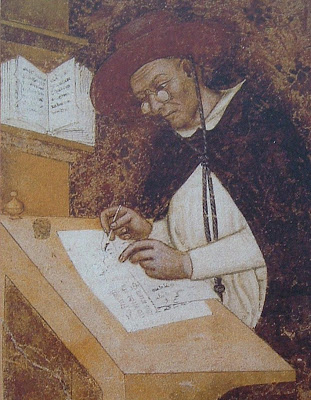
1230: Hugh of St Cher
Indexing textual knowledge
Hugh of St Cher and a team of 500 other monks create a concordance of The Bible.
1300

1300: Ramon Llull
Creating knowledge by combinations
Ramon Llull promotes a scheme for systematically creating knowledge from formal combinations of ideas.

1350: Nicole Oresme
Making pictures of data
French philosopher Nicole Oresme introduces the notion of drawing graphs of values.

1403: Yongle
Collecting the knowledge of a civilization
The Yongle Encyclopedia, assembled by 2,000 scholars, fills over 11,000 volumes with the collected knowledge of Chinese civilization.

1450: Vatican Library
The papal archives become the Vatican Library, which is still operating today.
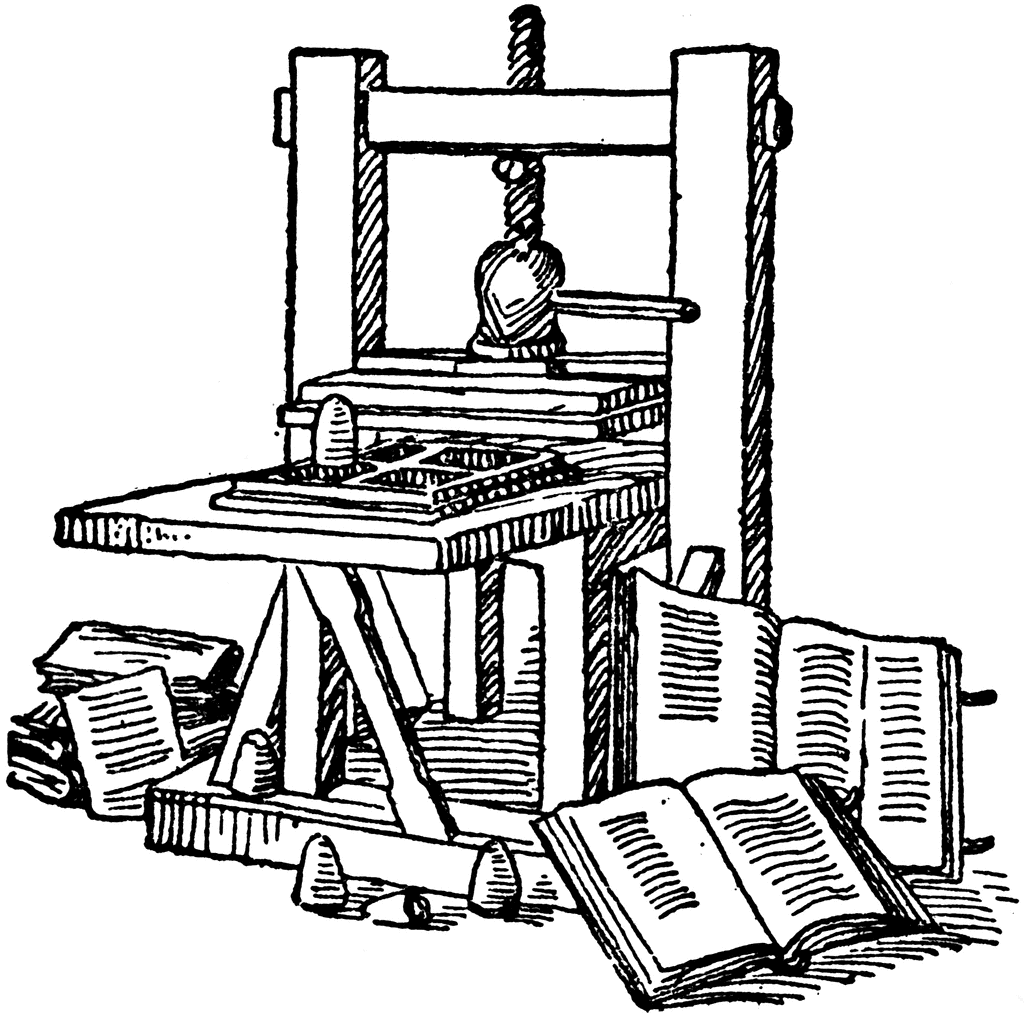
1453: Johannes Gutenberg
Mass distribution of knowledge
Moveable type makes it economical to print many kinds of documents.

1538: Parish Records
Recording life's events
Parishes in England keep weekly records of all christenings, marriages, and burials.

1582: Gregorian Calendar
Pope Gregory XIII establishes the modern calendar, changing the leap year rule for years divisible by 100.

1595: Symbolic algebra
Franciscus Vieta writes mathematical formulas with letters as variables, using vowels for unknowns and consonants for parameters.
We're continuing to update this timeline... Do you know some history we don't?
 We want your input »