
Timeline of Systematic Data and the Development of Computable Knowledge


 500 BC: Babylonian Astronomy
Using arithmetic to predict the heavens
The Babylonians introduce mathematical calculation as a way to find the behavior of planets and a few other systems in nature.
500 BC: Babylonian Astronomy
Using arithmetic to predict the heavens
The Babylonians introduce mathematical calculation as a way to find the behavior of planets and a few other systems in nature.
 500 BC: Pythagoras
Numbers are the key to nature
The Pythagoreans promote the idea that numbers can be used to systematically understand and compute aspects of nature, music, and the world.
500 BC: Pythagoras
Numbers are the key to nature
The Pythagoreans promote the idea that numbers can be used to systematically understand and compute aspects of nature, music, and the world.


20,000 BC

20,000 BC: Arithmetic
Counting abstract objects
The invention of arithmetic provides a way to abstractly compute numbers of objects.
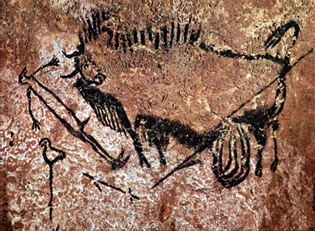
15,000 BC: Cave Painting
Representing events by pictures
The Lascaux cave paintings record the first known narrative stories.

3500 BC: Written Language
A systematic way to record knowledge
A central event in the emergence of civilization, written language provides a systematic way to record and transmit knowledge.

3000 BC: Registering Land Ownership
Babylonian stone boundary markers begin to include inscriptions that record ownership of land.
2500 BC

2500 BC: Sumerian Calendar
Organizing time
The first known calendar system is established, rounding the lunar month to 30 days to create a 360-day year.

2200 BC: I Ching
Symbols for destiny
The 64 possible hexagrams of the Chinese I Ching are taken to enumerate possible features of life and destiny.

2150 BC: Akkadian Measures
Making a standard for measurement
The Akkadian Empire adopts a single unified standard for measuring volume, based on the royal gur-cube.

1800 BC: Babylonian Census
Taking stock of a kingdom
The Babylonian census begins the practice of systematically counting and recording people and commodities for taxation and other purposes.

1790 BC: Code of Hammurabi
Codifying civil laws
Hammurabi writes down 281 laws prescribing civil behavior in the kingdom of Babylon.

1700 BC: Babylonian Mathematical Tables
Babylonians make tables of multiplication, reciprocals, squares, cubes, and square and cube roots.

1250 BC: Library at Thebes
A building to store knowledge
The Library at Thebes is the first known effort to gather and make many sources of knowledge available in one place.

1150 BC: Egyptian Maps
Recording geographic knowledge
The Turin Papyrus is the first known topographic map.
1000 BC

600 BC: Lydian Coinage
Coins to represent value
Lydia (in modern Turkey) introduces gold and silver coins to represent monetary value.
500 BC: Babylonian Astronomy
Using arithmetic to predict the heavens
The Babylonians introduce mathematical calculation as a way to track the behavior of planets and a few other systems in nature.

500 BC: Pythagoras
Numbers are the key to nature
The Pythagoreans promote the idea that numbers can be used to systematically understand and compute aspects of nature, music, and the world.


400 BC: Panini
Finding the rules of human language
Panini creates a grammar for Sanskrit, forming the basis for systematic linguistics.

387 BC: Plato's Academy
Teaching knowledge systematically
Plato founds his "Academy", which operates in Athens for nine centuries.

350 BC: Aristotle
Classifying the world and introducing logic
Aristotle tries to systematize knowledge, first, by classifying objects in the world, and second, by inventing the idea of logic as a way to formalize human reasoning.

325 BC: Library of Alexandria
Collecting the world's knowledge
The Library of Alexandria collects perhaps half a million scrolls with works covering all areas of knowledge.

300 BC: Euclid
Organizing mathematical truth
Euclid writes his Elements, systematically presenting theorems of geometry and arithmetic.

250 BC: Archimedes
Computing as a basis for technology
Archimedes uses mathematics to create and understand technological devices and possibly builds gear-based, mechanical astronomical calculators.

200 BC: Eratosthenes
Labeling the Earth
Eratosthenes creates the system of longitude and latitude and uses it to create a scaled map of the known world.

100 BC: Antikythera Mechanism
A machine for computing
A gear-based device that survives today is created to compute calendrical computation.

45 BC: Julius Caesar
Standardizing the months
Julius Caesar institutes the Julian calendar, establishing the lengths of the twelve months.
We're continuing to update this timeline... Do you know some history we don't?
 We want your input »